
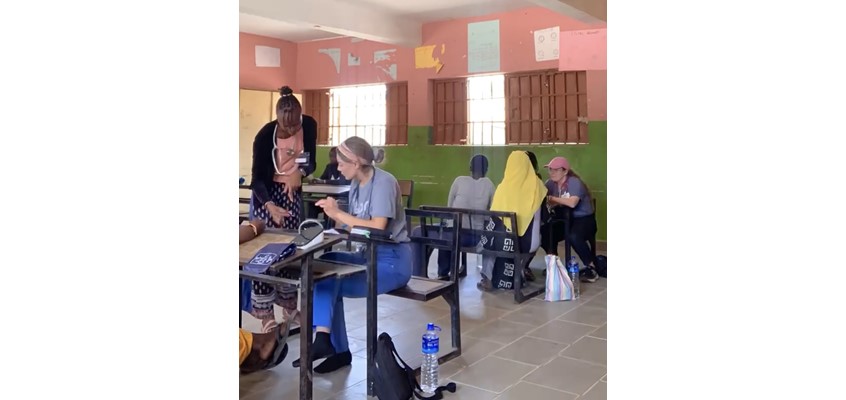
It has been one year since I went to The Gambia with Global Health Outreach, and I think what has surprised me most is not how much I remember, but how often it still comes up in ordinary life.
Not in dramatic ways. Just in the middle of clinic, or while studying, or even in conversations that have nothing to do with global health. It is less like a single experience I can point to and more like something that quietly rearranged how I see things, and I notice it in pieces.
When I went on that trip, I thought I had a decent framework for what I was stepping into. I had learned about global health in lectures. I understood the language—resource-limited settings, disparities, access. But standing in front of patients without the usual safety net made all of that feel very different. You are forced to decide what matters when you do not have everything available, and you realize quickly how much of your training assumes that you will.
That has followed me back into every rotation since. I think more carefully now about what I am ordering and why. I pay more attention to what a patient is actually trying to say instead of just fitting their story into something familiar. I notice how often we rely on systems that work well here, and how different things would look if they didn’t. It has made medicine feel less like a checklist and more like a responsibility that requires a different kind of attention.
There is also a tension that I did not expect. I came back to a system with resources, structure, and predictability after spending time in a place where those things are not guaranteed. That contrast does not really go away. It shows up in small ways—what we consider urgent, what we take for granted, how quickly we move on from problems because we assume they can be addressed later. It has made me more aware of how uneven access to care really is, not just internationally but here as well.
At the same time, that trip is also tied to something much more personal for me.
I met my husband there.
It did not start in any kind of dramatic way. It was mostly conversations—about faith, about why we were there, about what we believed and how that actually showed up in our lives. It turned into a friendship that continued after we got back, and then into something more serious over time. We got engaged, and this past February, we got married.
So when I think back on that trip, I am not just thinking about clinical experiences or what I learned in a professional sense. I am thinking about the fact that my entire life looks different now because of it. The person I am building a life with is someone I would not have met otherwise, and that alone is something I could not have anticipated when I signed up to go.
That connection has also shaped how I think about calling. Before the trip, global health felt like one of many possible directions. Now it feels more integrated into how I understand my future in medicine. Not necessarily in a narrow sense of where I will go or how often, but in how I think about who medicine is for and how far I am willing to go to reach people who do not have access to care.
I did not go back this year, and I felt that more than I expected. There is something about returning that feels like a continuation, and not being there made me realize how much that experience had settled into my life in ways I did not fully recognize at first.
A year out, I do not think I can summarize the trip in a clean or complete way. It did not give me a single takeaway or a simple sense of clarity. It changed how I think, what I notice, and what I take seriously. It is still shaping how I move through my training and the kind of physician I am becoming.
And, in a way I could not have planned, it also shaped who I am becoming outside of medicine too.
Not in dramatic ways. Just in the middle of clinic, or while studying, or even in conversations that have nothing to do with global health. It is less like a single experience I can point to and more like something that quietly rearranged how I see things, and I notice it in pieces.
When I went on that trip, I thought I had a decent framework for what I was stepping into. I had learned about global health in lectures. I understood the language—resource-limited settings, disparities, access. But standing in front of patients without the usual safety net made all of that feel very different. You are forced to decide what matters when you do not have everything available, and you realize quickly how much of your training assumes that you will.
That has followed me back into every rotation since. I think more carefully now about what I am ordering and why. I pay more attention to what a patient is actually trying to say instead of just fitting their story into something familiar. I notice how often we rely on systems that work well here, and how different things would look if they didn’t. It has made medicine feel less like a checklist and more like a responsibility that requires a different kind of attention.
There is also a tension that I did not expect. I came back to a system with resources, structure, and predictability after spending time in a place where those things are not guaranteed. That contrast does not really go away. It shows up in small ways—what we consider urgent, what we take for granted, how quickly we move on from problems because we assume they can be addressed later. It has made me more aware of how uneven access to care really is, not just internationally but here as well.
At the same time, that trip is also tied to something much more personal for me.
I met my husband there.
It did not start in any kind of dramatic way. It was mostly conversations—about faith, about why we were there, about what we believed and how that actually showed up in our lives. It turned into a friendship that continued after we got back, and then into something more serious over time. We got engaged, and this past February, we got married.
So when I think back on that trip, I am not just thinking about clinical experiences or what I learned in a professional sense. I am thinking about the fact that my entire life looks different now because of it. The person I am building a life with is someone I would not have met otherwise, and that alone is something I could not have anticipated when I signed up to go.
That connection has also shaped how I think about calling. Before the trip, global health felt like one of many possible directions. Now it feels more integrated into how I understand my future in medicine. Not necessarily in a narrow sense of where I will go or how often, but in how I think about who medicine is for and how far I am willing to go to reach people who do not have access to care.
I did not go back this year, and I felt that more than I expected. There is something about returning that feels like a continuation, and not being there made me realize how much that experience had settled into my life in ways I did not fully recognize at first.
A year out, I do not think I can summarize the trip in a clean or complete way. It did not give me a single takeaway or a simple sense of clarity. It changed how I think, what I notice, and what I take seriously. It is still shaping how I move through my training and the kind of physician I am becoming.
And, in a way I could not have planned, it also shaped who I am becoming outside of medicine too.